If you follow me on Instagram, you might have noticed that ‘unselfish sewing’ has reared its crystal-encrusted dancewear head. Sorry. Not sorry.
Due to the length of the project I’ve broken it up into several posts – I won’t drag them out over weeks. One a day for three days.
I finally (after 10 years) dipped my toe into sewing my daughter’s dancewear. I’d seen enough ugly garnish dancewear to deter me… but in the end curiosity got the better of me.
I started with a tutu. I know, nothing like jumping in at the deep end! However I jumped in with a life buoy – or rather a tutu sewing workshop.
I had been web stalking an Australian tutu maker Dani Legge as I’d been pondering this adventure for a few years and my pattern research always seemed to lead me back to an Australian: Dani Legge. She’s a bit of a legend in the tutu world, particularly the stretch tutu.
When I saw a tutu workshop with Dani pop up on facebook, that was based on the Gold Coast in June, I decided to sign up.
There were two options, sewing a traditional tutu over five days (patterns by Suzanne Dieckmann of Tutus That Dance) or Dani’s stretch tutu over two days.
While the immediate choice seemed to be a traditional tutu from a sewing point of view for myself. I thought “this isn’t about me” (first step in selfish sewing recovery).
After a discussion with my 13-year-old daughter who would be wearing the tutu, I opted for the stretch tutu class. She finds them more comfortable and didn’t think the visual difference was enough to sacrifice comfort – and she’s growing. A stretch tutu will go the distance and can be sold/handed down to another dancer.
The Concept & Materials
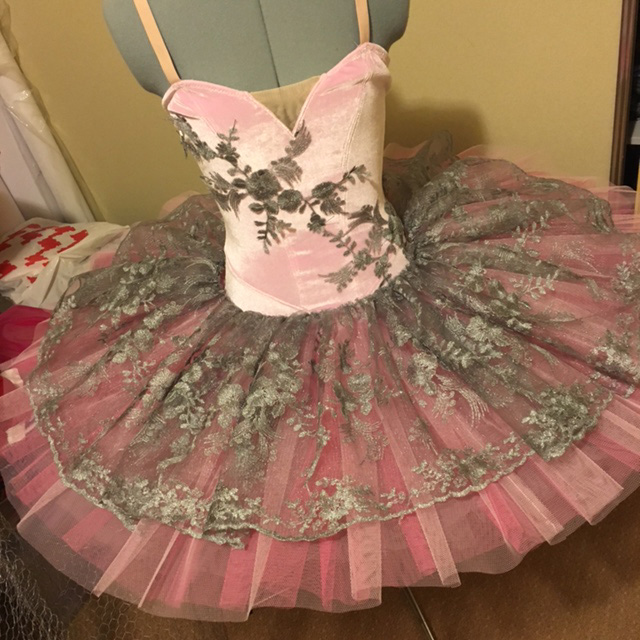
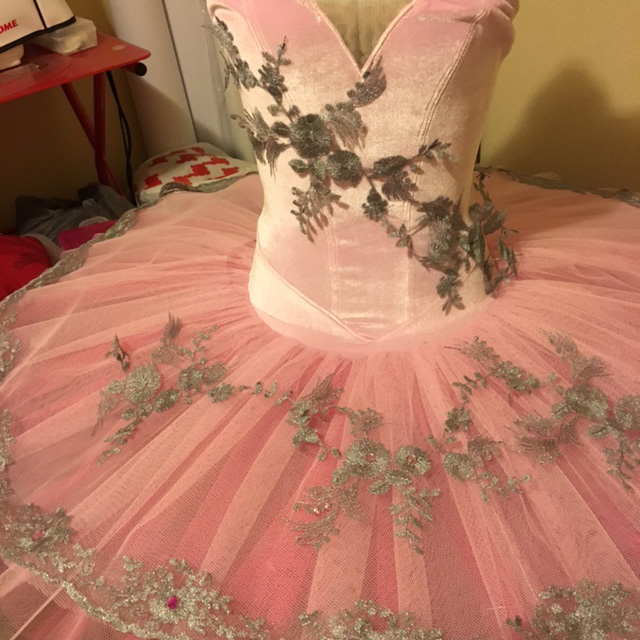
While I initially planned for a claret/gold/cream tutu, I had a sudden burst of inspiration and created a pink/grey/silver tutu instead. My daughter thought it was a hideous concept but said “well I don’t like pink but it’s your first one & it won’t be very good anyway. So better to make that first and then my dream claret one next.” Ah…. such faith she had in her mum!
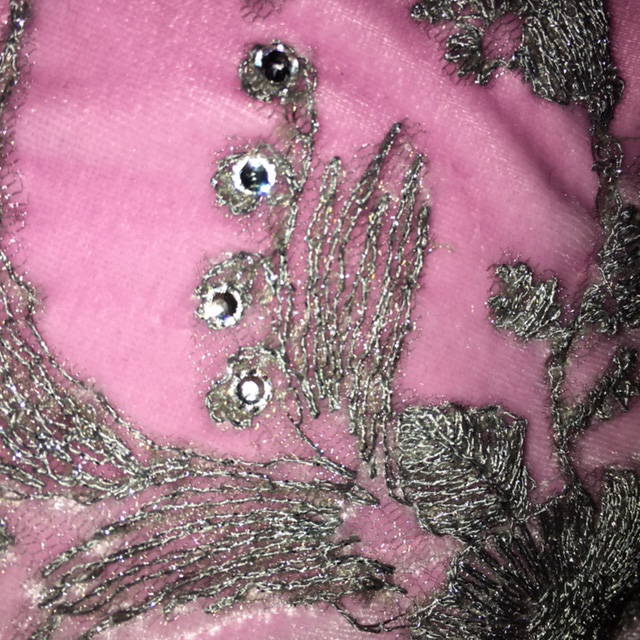
I decided to use stretch velvet (against the advice of Dani but complying with my daughter’s wishes) and layer three colours of netting into the plate:- light pink, dark pink & grey. I found some lovely silvery grey lace/net fabric. All fabrics from Spotlight, Australia.
I was the only one at the workshop sewing with velvet & I did curse myself a few times for being pigheaded. Such is life!
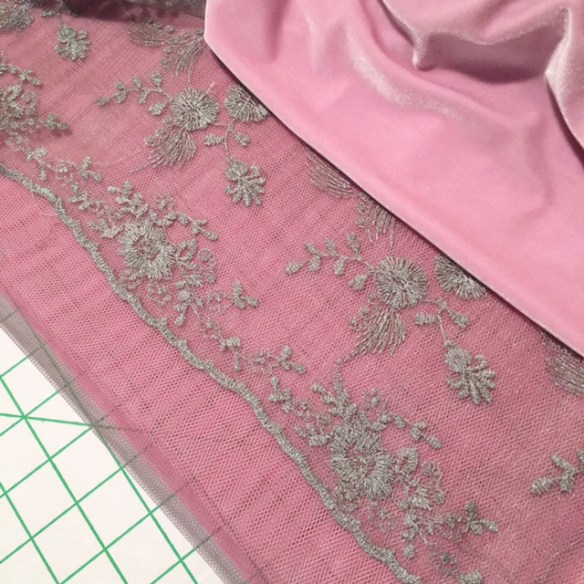
My materials – stretch velvet, silver lace and dark pink, light pink & grey netting
I won’t lie, the velvet was difficult. And while I was told to take ‘lining’ for the tutu, I interpreted that as stretch lining. However what I needed was just plain old Lycra. Fortunately a lovely lady had extra and provided my lining on the day. And it wasn’t what I think of as lining, more of underlining – two layers to give the tutu more body.
The tutu plate is made from netting – not soft fluffy tulle. Stiff stratchy netting from Spotlight… about 12 metres of it. You want tough netting so the plate doesn’t collapse.
The silver/grey net/lace fabric I ended up using differently to my original vision – part of the creative journey!
The Leotard
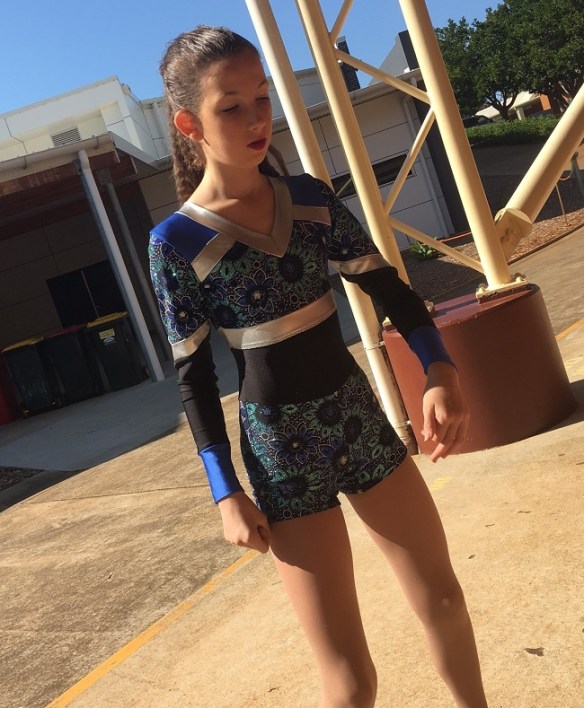
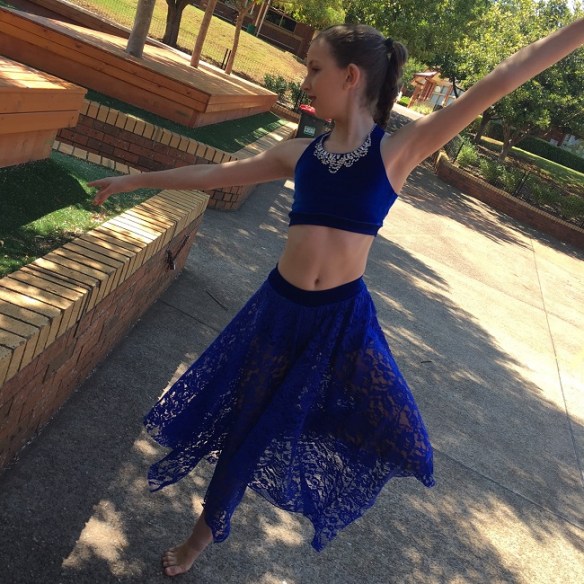
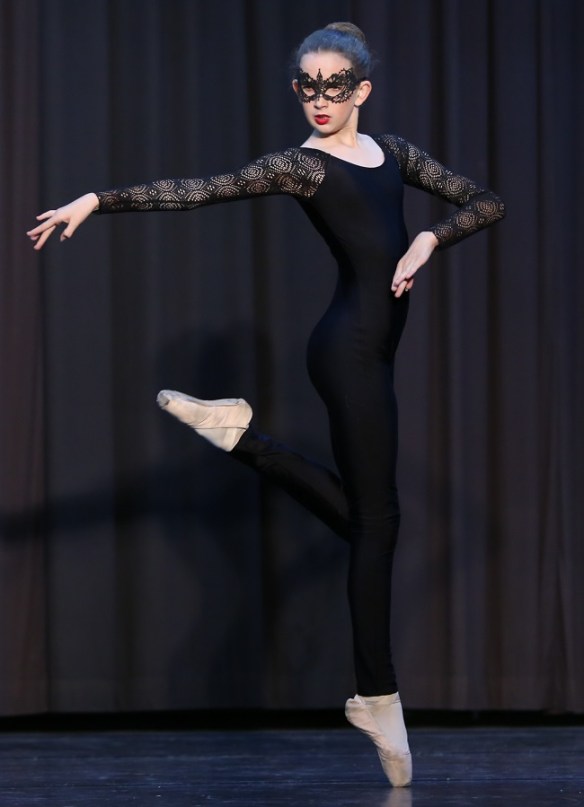
I’m glad I did this course as it gave me the confidence to sew more than a tutu. I’ve gone on to sew a unitard and a jazz ‘cheerleader’ style outfit for my daughter. I still have a contemporary outfit to go.
Nothing dramatic to report about the leotard – except we left the crotch seam open to attach the netting plate.
All the seams are top stitched – with my ‘lightening bolt’ stitch on my Bernina.
The entire leotard is underlined or lined with plain pink lycra – except below the waist which is just one layer or plain lycra – not velvet. The velvet pile can cause odd effects when the light hits it… and there are some places you don’t want ‘weird’ distracting shine if you get my meaning! So no velvet below the waist.
I also didn’t sew down the back straps – this was the very last thing I did before my daughter wore it!

The tutu leotard – minus the plate
Everyone asks how much netting I used. I used around 10-11 metres, maybe less. There are eight rounds of netting sewn on. Each round is created by cutting across the netting’s width (150cm) four times and then sewing these into a 6 metre long strip. Each strip becomes progressively narrower as you sew the layers (sewing on the upper layer first).
So once you add up 8 times 6m of netting strips… yes, that’s a lot of netting to sew to the bottom of a leotard!
I gathered each layer using fishing line. This is a great method, particularly for this as the netting gathers as you zig-zag over the fishing line – and more or less slides out after you have attached to to the leotard. More or less because nothing is ever that easy!
However I would recommend using fishing line to gather a tough fabric like netting (some use dental floss for this purpose but fishing line comes in huge cheap reels!) especially long lengths as 1) it doesn’t snap like thread can under pressure, and 2) if you run out of thread while attaching the fishing line you can just start zig-zagging over the fishing line again where you left off. How do you do it? Simply put the fishing line down on the fabric, set your machine to a decent width zig zag, hold onto the fishing line behind your machine foot and off you go – and by placing a little tension on the fishing line in front of your foot as it is feeding through, you will discover the material tends to begin gathering behind the foot as you sew. Magic! You can adjust the gathers easily enough afterwards.
As the day progressed, my machine slowly began to disappear under the layers of netting and my shoulder ached from pushing the netting away and pushing the leotard and netting under my machine foot!
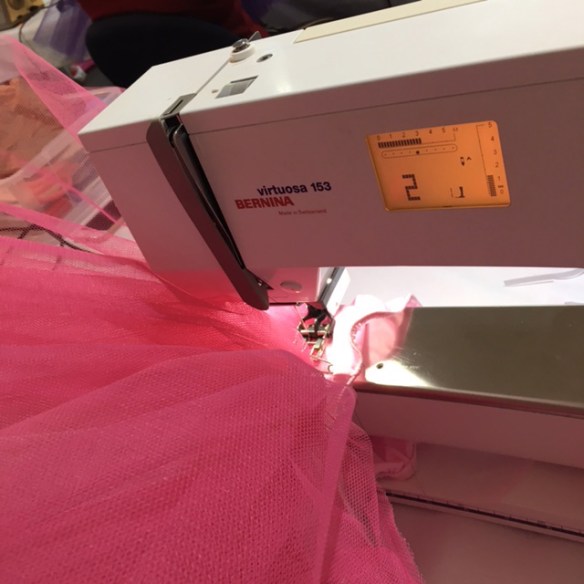
Attaching the netting – at this stage I thought “this isn’t going to be that hard” Little did I know!

The first layer of darker pink and then grey
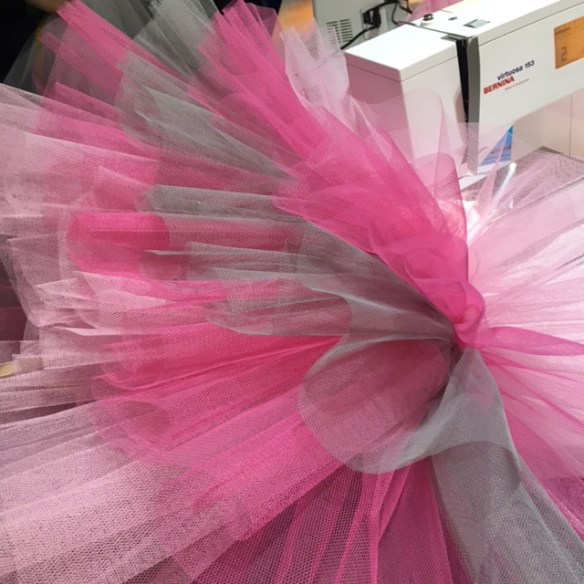
Top layer of light pink, followed by darker pink, grey, darker pink and then the lower levels of light pink. I wanted to avoid a bumble bee look so went for teh subtle effect to achieve depth in the plate rather than high contrast
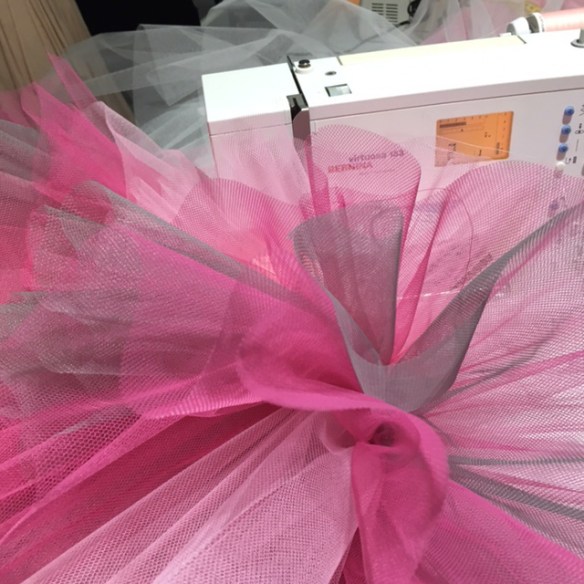
Drowning – and tired – and desperate at this stage!
I snapped five needles in the last two rounds. I was not happy and desperately wanted to quit with about 3 inches to go. Seriously. This is when I was very relieved to be at a workshop as I might have thought it was too hard, that my tutu was going to look awful anyway – but Dani is quite calm & zen about tutu-traumatized students and got me through it.

Needle tips everywhere! I think I found them all!
Finished – exhausted and ‘over it’

I just tossed it aside at this point and walked around in circles.
OMG – this is a real thing!

The untagged tutu – fluffy!
Dani uses a tagging gun to wrestle the plate into submission. A traditional tutu you would hand baste together with a supportive hoop. I would love to learn this – maybe next year!
After the few hours of wrestling and attaching netting, steaming and tagging the tutu together was surprisingly fast and gratifying. Within 30 minutes I had a tutu to decorate.

Not my tutu – however the upper layers are held out of the way and you start at the smaller lower layers first. Steaming and tagging in a staged process.

Tagging
Sewing my velvet pieces together the wrong way – the first seam! Unpicking stretch is tedious. Unpicked velvet is nightmare inducing as it marks!
I sewed my leg elastic to the wrong side. Yes, had to unpick that as well!
Breaking FIVE needles.
Final thoughts
Tutu sewing is exhausting! The leotard bit is comparatively easy compared to the epic wrestle of attaching a tutu plate to the leotard. I thanked the sewing gods every stitch for my walking foot and a relatively weighty tough Bernina.
To be honest, without that workshop and the amazing patient and calm Danni, I wonder if I would have had the faith in myself to push through the final, swear word-riddled final stages. I often felt defeated, exhausted and doubted myself.
I highly recommend a workshop for even just the companionship and encouragement that comes with a group learning experience.
Is it the best sewing I’ve done? No. However it’s my first tutu. It’s a learning experience!
However, the tutu journey didn’t end here… I packed my tutu pack in the car and went home to decorate/embellish it.
Next up – the Creative Process!













 Sew Busy Lizzy