The Shining Archer… Grainline Studios

or the Twilight shirt… it reminds me of how Edward’s skin in the Twilight movies sparkles like diamonds in the sunlight.

This is yet another project that has taken me forever to blog. I finished this shirt just after Christmas. The threat of rain inspired me to get out late this afternoon & get some shots! My kids love this shirt.

I’ve been obsessed with sewing some more shirts. I really enjoy shirts, shirtdresses… all those little details and pieces really appeal to me.

I sewed the Archer several years ago – my first shirt… in silk no less!

I’ve always wanted to return to this pattern but there have been many distractions since then.

Last month I picked up some ‘foil’ crinkle cotton from The Fabric Store in Brisbane. I would describe it as fancy cream-coloured cheesecloth – that lovely, soft cotton, crinkled fabric – coated in a light silvery foil. It seemed appropriate to sew my own Shining Archer – as knights in shining armour are a bit thin on the ground these days.
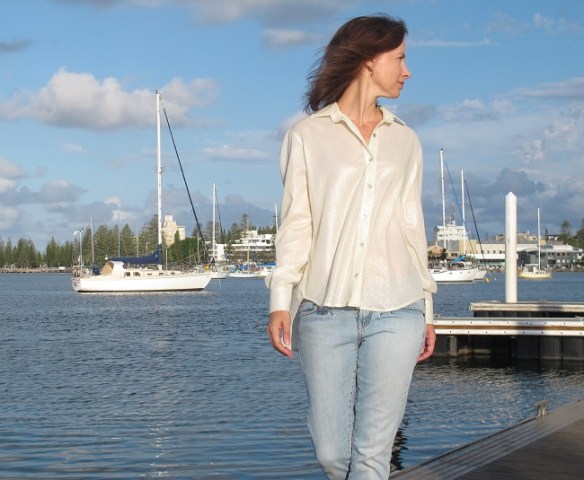
Grainline Archer Shirt - front view

Grainline Archer Shirt – front view

The texture of the fabric had put me off. I was concerned that it might stretch and distort as I sewed. My concern was misplaced as it proved to be very easy to work with.

I opted to make the Grainline Studios Archer in View B with the ‘ruffle butt’ feature.

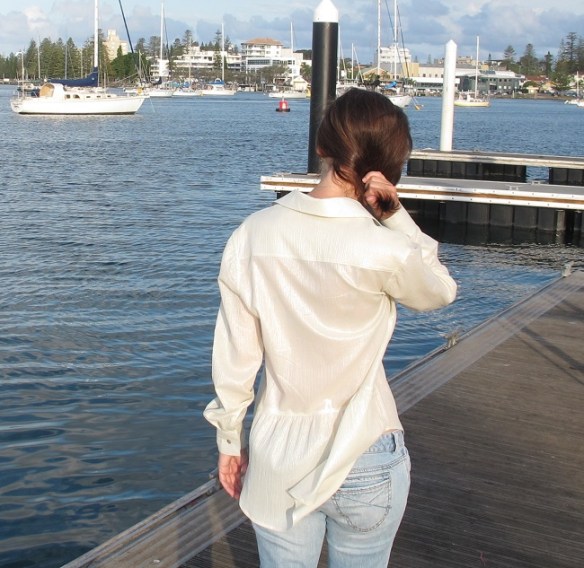
I sewed size 0 and while it’s oversized by nature, in this shining fabric I feel like that over-sized fit looks more exaggerated. Any folds or excess fabric catches the light and highlights them.
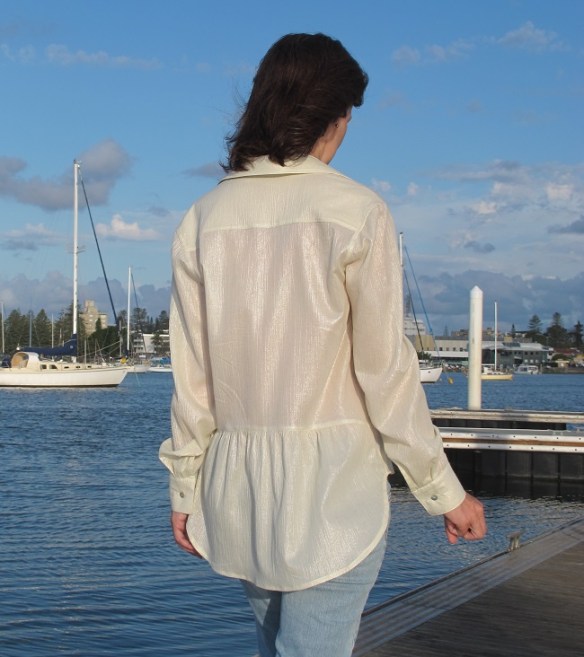
Grainline Archer Shirt - back view

Grainline Archer Shirt – back view

Grainline Archer Shirt - back view

Grainline Archer Shirt – back view. Afternoon breeze makes this look more fitted than it is! LOL

I decided to leave the pockets off as the fabric is so light and delicate that the pockets felt too large and heavy.

I often sew with a similar RTW garment beside me – to check details, techniques and so on. I noticed in all the RTW shirts in the house that the sleeves has been set-in with flat felled seams. I also wanted to do this as the fabric is quite sheer and I didn’t want to seam allowances to shift about and look untidy. I think those little details really irritate me.

Unfortunately I realised this after I had cut out all the fabric – and I hadn’t allowed enough in the seam allowances to accommodate this… so I just faked them by top stitching down the seam allowances. I’m a little disappointed however the outside finish is still quite nice. It’s our little secret.
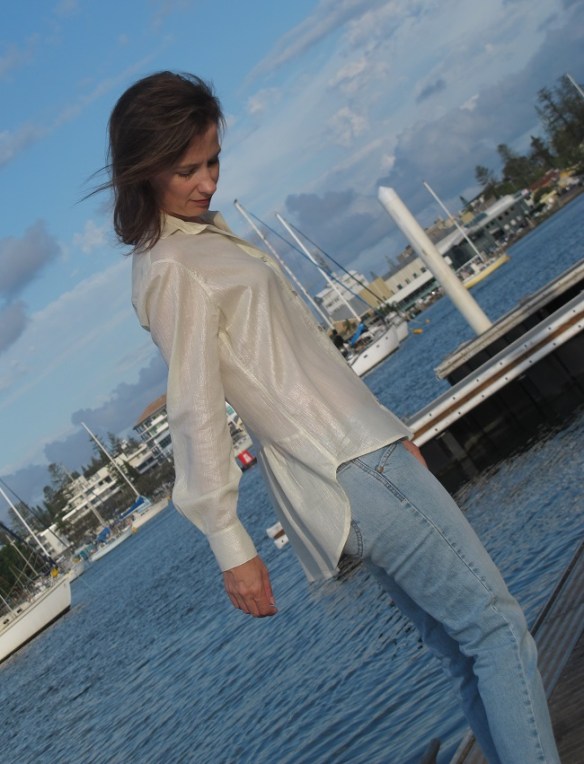
Grainline Archer Shirt - side view

Grainline Archer Shirt – side view. Again – more afternoon breezes!

Grainline Archer Shirt - side view

Grainline Archer Shirt – side view

I also attached the collar using the Four Square Walls method. I always hand stitch the lower edge of the inner collar band in place before I top stitch the band. I had a little giggle when Handmade by Carolyn posted about how she does this too – I had always wondered how many others couldn’t achieve a neat collar finish without the help of a little more hand stitching than a pattern dictates! I think it results in the neatest finish and as I tend to sew a shirt over several shorter sewing sessions, a little more time spent hand stitching really isn’t onerous.

I will also confess that I often machine baste a line of stitching along the finished stitching line of the collar band and then press a crease along this before I sew the collar. Then when I do go to turn the collar band edge and hand stitch it in place, it is precise. Pedantic I know.

I also hand stitch the inside of the cuffs closed before top stitching the cuffs as… I guess I can just be a little obsessive about the strangest little things. I’m a little bothered by my cuffs rather ‘flappy’ ends and thinking about putting a second button on them to keep them neat against my wrists.
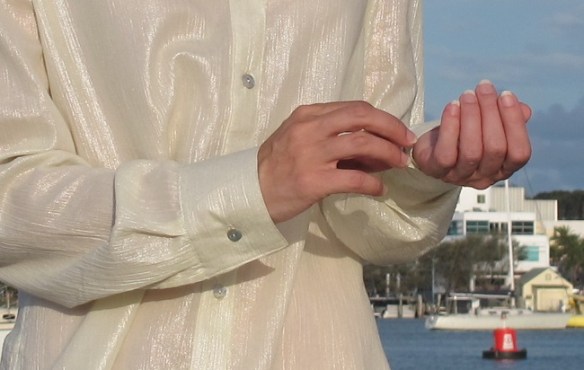
Grainline Archer Shirt - the cuffs

Grainline Archer Shirt – the cuffs

I know some replace the Archer plackets with tower plackets, I opted to stick with the pattern. This fabric is so light and sheer I preferred the original more delicate plackets of the Archer pattern.

Really there is not much more to say about the Archer. It’s a nice reliable staple shirt pattern.

I uncovered my David Coffin Shirtmaking books during my sewing room clean-up and I can see more shirts in my sewing future.

Pattern: Grainline Archer
Fabric: Foil Crinkle Cotton, The Fabric Store (Brisbane)
Also see: my all-time favourite Archer…. True Bias. And just Google Grainline Archer – this has been made over and over and over again!

Random: I’ve been running 5km a week for the last month, just on Saturday mornings. It’s a bit of a new year’s resolution that I haven’t ignored. While I hate ‘times, ‘weighing’ or anything that numerically tracks my progress, today I took another 96 seconds off my time. I’m not fast or pushing myself too hard but I’m doing OK for starting at ‘ground zero’.

PDF patterns – let’s talk

I’m interested in hearing people’s experiences, thoughts and suggestions about the supply of PDF patterns – and I think people are interested in talking about it too. 

I’m not talking about the companies, independent vs Big 4, their designs, grading, ease or sizing… just simply the supply of PDF patterns.

Over the Christmas break I decided to sew a shirt using a PDF pattern I’d purchased in a sale. It turned out I didn’t sew that shirt as I couldn’t stomach sticking together 40+ A4 pages on an exceptionally hot summer afternoon.

I decided to clean my sewing room instead. It’s interesting that I considered my time was better invested spending days tidying my sewing room rather than sticking together A4 pages on one afternoon. I think that’s because no one else could/would tidy my sewing room but there are other ways a pattern can be supplied or printed.

I posted on Instagram, curious how other people felt about PDF patterns, how many disliked the A4/letter assembly… was I just precious?

The post generated over 180 comments. Some people love pdfs, some loathe them and others lie in that 50/50 camp of love/hate. And for some, such as myself, the love is conditional on how the print file is supplied.

My experience

I do like PDFs as storage isn’t an issue until you print them. I usually trace them off & read the instructions on my phone/iPad or print the instructions (if I feel I need them) in booklet format to save paper. I rarely keep the actual printed pattern once it’s traced.

I do like paper patterns and have an extensive collection. However with some paper patterns I’ve purchased online I often pay at least $10 postage in addition to the cost of the pattern. I can print an A0 sheet for $4.10. So in some cases the cost is much the same.

PDF A4 (or US letter) assembly patterns

I have tried glue, sticky tape, a paper trimmer, using a huge window, doing them in sections. I can do it quickly, efficiently and precisely. That’s not my issue. It’s not that I can’t do it – I loathe doing it. Like many people, I am time poor and I have become very ruthless with how I allocate my time. I’m also quite intolerant of having my time treated as ‘disposable’.

I’m OK with about 15 or so pages. I think once you reach in excess of 25 pages, as a business you may like to consider the customer experience of the pattern.

Printing

I think there will always been a need to supply A4/letter print formats – the availability of this type of printer is widely available & often in the home or workplace.

Some people do not have access to commercial large format printers. So the choice will always be paper patterns (commercial or independent) or using their home printer for smaller A4 or US letter sheets.

I don’t print my patterns at work. I print at home or use Officeworks (a chain stationary store that also supplies printing services) for large format printing. I have a strong preference for PDF patterns that are provided in A0 format. I dislike patterns that require me to find a commercial printer with a plotter – the patterns which require ‘roll printing’. They are often located in professional design/engineering offices that often don’t supply printing as a normal business service so that in itself is cumbersome to navigate – and frankly… I can’t be bothered.

Here in Australia, many larger regional centres and most city areas have access to a stationary supplies chain store Officeworks which offers A0 printing services for $4.10 per sheet. I know it’s not the case for everyone but I’d rather pay that & I have my time back.

I understand the ‘immediate satisfaction’ that some love, being able to print & immediately start sewing. I tend to plan in advance due to my limited time to sew. So that for me isn’t an issue.

Feedback

I have been contacted by a few designers since that Instagram post. And one of the things that stuck in my mind from those emails and messages was that some companies hadn’t considered  the end-user experience or how we might access printing for PDF patterns.

They also inquired what printing was available. From the instagram comments, it’s evident that printing is largely dependent on location in a metro or regional area – and country.

I did think about creating a Google Forms document to collate the data – however I’m not in the business of advising companies how to run their businesses. I just see this as a discussion forum. If they are interested (and the response to the Instagram posts indicates they are) they can read your comments. 

I think it’s important to acknowledge that a company has a target market and will supply their product accordingly. If they aren’t interested in growing their market share by modifying their product to suit the needs of a new set of customers – that’s absolutely fine. It’s their business.

How you would like your PDF files supplied? What’s your country of residence, printing costs/availability and file type preferences?

Note: I have no financial interest or affiliation with any pattern company. I’m also not in the business of advising pattern companies. This is simply a sewing community discussion.

… I’m going to let this discussion run its course so I may not reply to every comment. I’ll be reading them though. I’ve got a lot going on right now so if I’m quiet that’s why.

Ogden Cami Dress

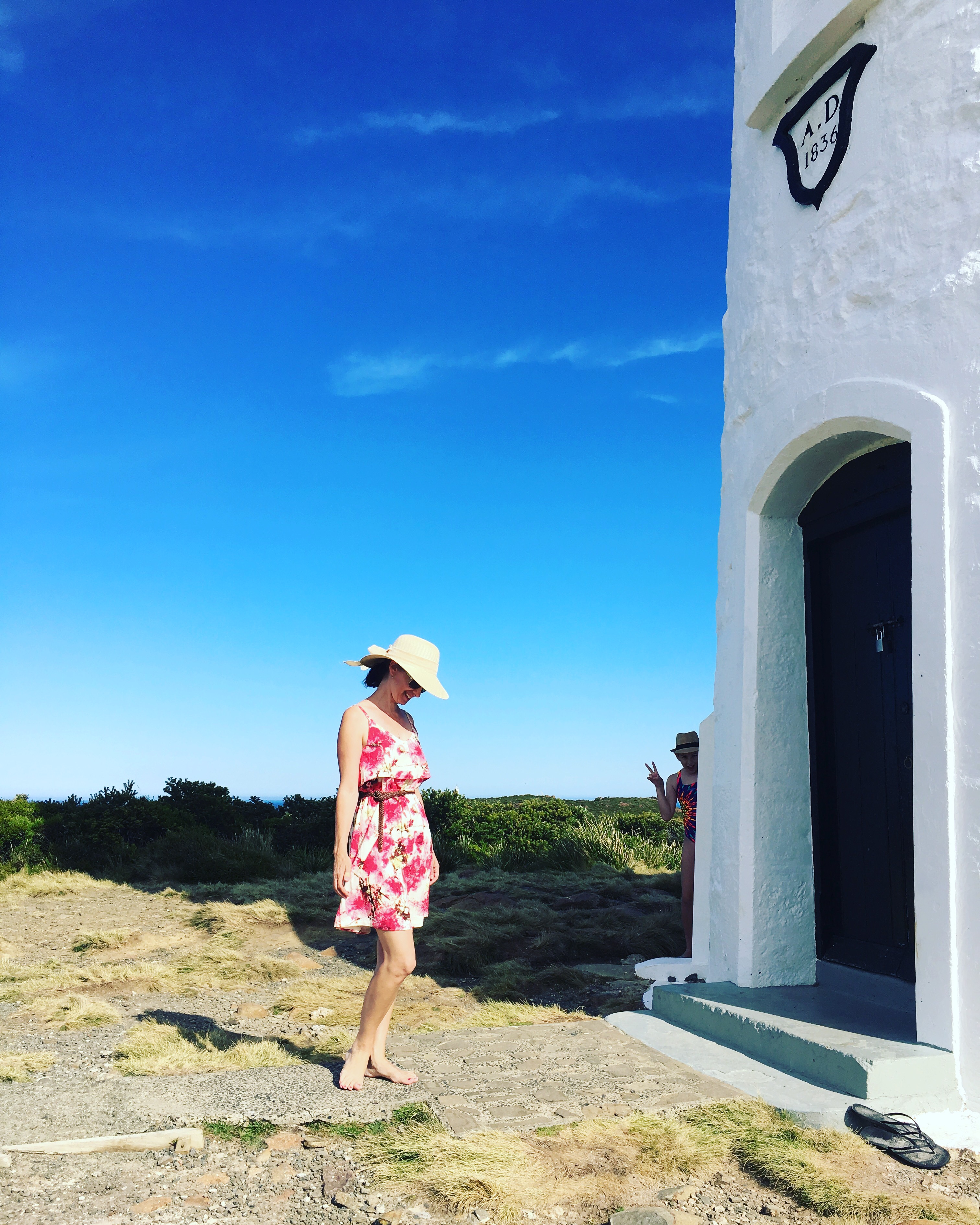
A quick holiday post, from the spectacular Bruny Island, Tasmania, Australia.

I wasn't 'in love' with this fabric when I purchased it, just its drape. Now it's sewn up I rather love the print

I wasn’t ‘in love’ with this fabric when I purchased it, just its drape. Now it’s sewn up I rather love the print

I suspect the True Bias Ogden Cami may be a popular Australian summer sewing pattern with many. I think the sleeveless, casual style & being a pattern for ‘wovens’ makes it perfect for steamy summer days.

This is just another experiment for yet another Ogden Cami Dress ‘hack’ that have been topping up everywhere. Far from perfect but I’ve worn it a few times already, so perhaps a success anyway!

I use the term ‘hack’ loosely. No pattern drafting going on here.

I simply extended the Ogden Cami hemline, flaring it out about 1/2inch on either side from about 1 inch below the armhole.

Odgen Cami Dress

Odgen Cami Dress

I flared the lining piece at the sides I don’t think I would I worry about this modification next time as the cinching in of the waist achieve that soft overlay flare anyway.

I attached the lining to the outside of the cami bodice rather than the inside, treating it like an overlay rather than a lining.

I decided where I wanted my waistline to be and allowed for a slight blouson effect.

Odgen Cami Dress

Odgen Cami Dress

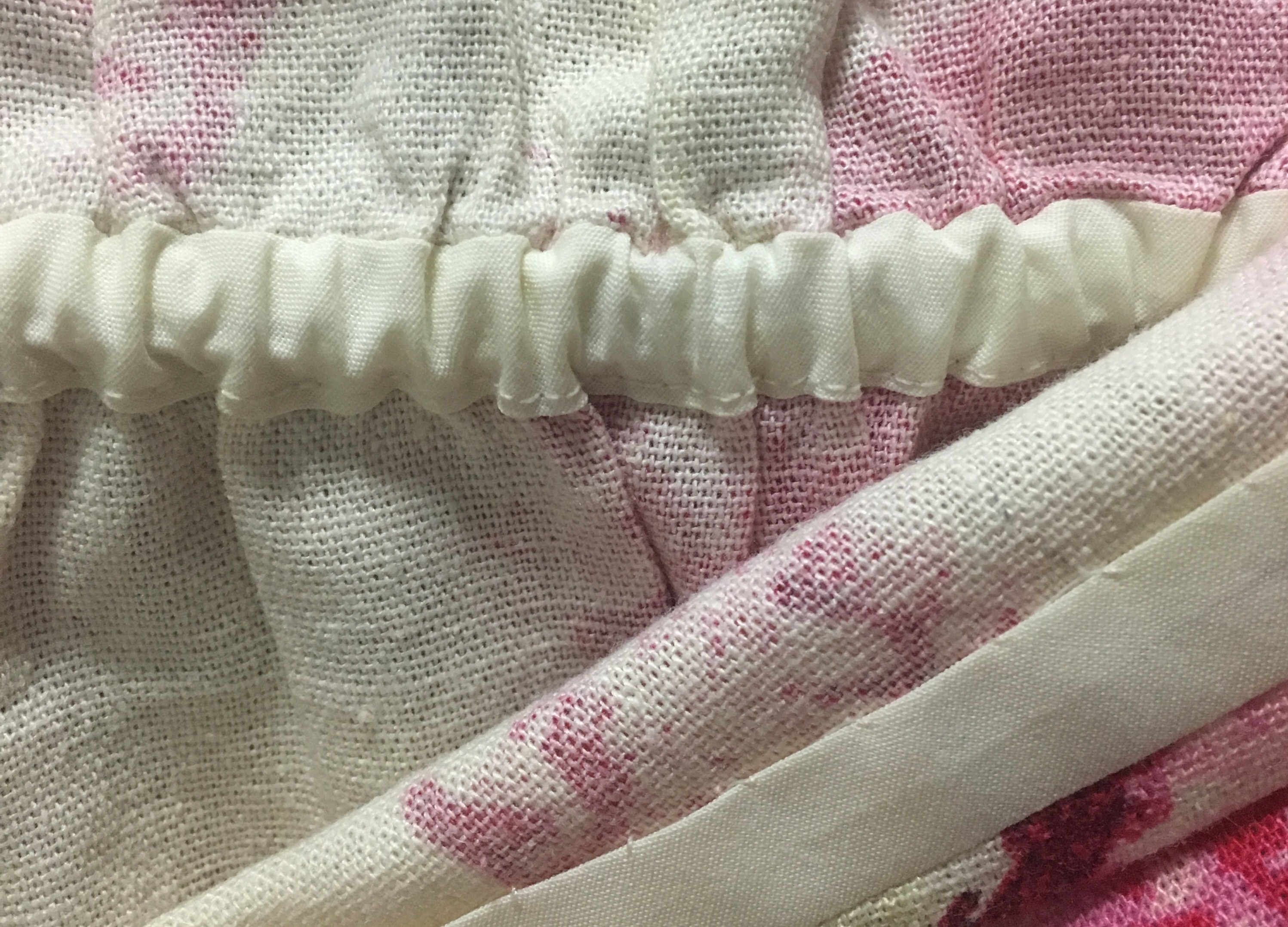
To create the waistline, I attached bias tape to the inside of the dress. I first stitched along the inside of the bias tape, along the fold line. I pressed it downwards and edge stitched along the other edge of the bias tape.

Ogden Cami dress - internal - waist elasticity casing & hem.

Ogden Cami dress – internal – waist elasticity casing & hem.

I left a stitching gap and then threaded some 1/4in elastic into the bias tape channel.

I turned up the overlay and dress hemlines with more bias tape – and hand stitched the hems in place.

Nothing fancy but it’s quite a cute little dress for summer.

Pattern: True Bias Ogden Cami, modified

Fabric: rayon/linen blend fabric on Lincraft

Location: water shots at Jetty Beach on route to the Cape Bruny Lighthouse, Tasmania. An incredible day in an amazing place in the world. Not overly ‘touristy’ just divinely beautiful, unspoilt & the journey ‘off the beaten track’ is well worth the effort.

2017 – a year of random sewing

… or why I don’t have sewing goals…

It’s that time of the year when most of us focus on what we would like to do for the coming year – in all areas of our lives. I’ve been thinking a lot about a lot of things lately – which in part prompted the sewing room de-stash and reorganisation (let’s not discuss the horrendous mess it had become lol).

It was during The Great Sewing Room Clean Up that I found a postcard I had purchased in Madrid. It says simply “the chief enemy of creativity is good sense” Pablo Picasso. It got me thinking and I’ve hung it on my peg board.


As a general rule I am a goal-orientated person. I can be fiercely competitive and work myself into the ground in order to defend a hockey goal, meet a work deadline/target or get my children to their various activities.

Despite my relentless drive I have little or no interest in setting myself sewing goals.

Perhaps this is because my motivation to sew isn’t often practical. I sew when a fabric inspires me… I am hit by the urge to try a pattern… I am suddenly obsessed with having a specific garment… all of these things and more. My motivation is primarily creative – not practical. 

For me, practical or goal-driven sewing can be stifling. Not inspiring.

So much of my life is consumed by work and family goals, commitments and requirements that I don’t want to be that person here. The blog, or my sewing room, is where those demands, or required behaviours to achieve them, don’t apply. It’s simply where I let things ‘happen’ and that for me is the great joy of sewing. 

I appreciate that’s not how it is for others but it’s how it is for me. So I’m embracing that rather than fighting it. It’s no better or worse than any other approach, it’s just my approach.

In 2017 I’ll simply embrace creativity and see where that takes me.

I will sew and blog when I feel the urge. 

I may sew fabrics from my stash. 

I may sew the jackets which I have traced and have fabric waiting for… but don’t hold your breath waiting for them. 

Tomorrow I may pat a fabric that demands to be made immediately into a dress. I’m OK with that.

No hashtags required. Just random sewing.

Right now I’m in beautiful Tasmania. No sewing just picking raspberries, counting echidnas and sleeping.


Happy New Year & a ‘new’ room

Hello & happy new year!

I’m still working my way through the backlog of 2016 posts but in the meantime I thought I’d quickly post what I’ve been up to…

Tidying up my sewing room!

I felt suffocated by commitments and responsibilities in 2016. I took on too much in 2016. I said ‘yes’ too many times when I should have said ‘no’. I felt obligated to help others, going out of my way to make time for people, even those who didn’t deserve or appreciate it – much less understand the pressure it caused. 2017 will be different.

While I’m figuring out how to get through 2017, I decided that I would tackle my ‘life junk’.

I started with my sewing room.

I’m not a ‘super mum’ and I loathe the term. I doubt there are any. I’m just another person trying to juggle too much, too often. It’s impossible to do everything all the time – although I do like to kid myself I can. Sometimes you manage to pull it all together… those are the good days…. sometimes you cry, you panic on route to the next kid pick-up, you lose your temper, your patience and everything else along the way… but life goes on regardless. That’s just life really.

I love to sew. It clears my head. However as 2016 proceeded to spin out of control and then run me over like a freight train, my time to sew dwindled dramatically and so did my time to tidy/clean etc – not just my sewing room but anything. Life became increasingly chaotic. Then it became difficult to sew because I felt overwhelmed by the ‘mess’ in my sewing room. And everywhere to be honest!

So on New Year’s Eve I decided it was now or never. I need to change some things in my life and it seemed the logical place to start… in my former ‘happy place’.

It may have been unbelieveably hot and humid but I didn’t let that deter me from my mission.

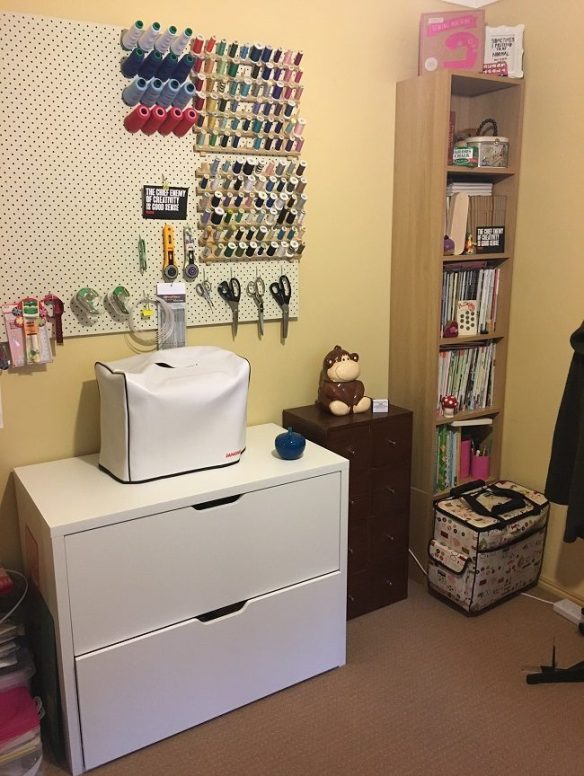
I got a filing cabinet for my patterns and a new desk for my machine and overlocker. My coverstitch sits atop my pattern storage as it is not used a frequently as the other machines.

My room now has a pegboard. My sewing reference books, Japanese pattern books, magazines, patterns and tools are neatly put away… and easy to locate.

My pattern storage, pegboard and book shelf.

My pattern storage, pegboard and book shelf. Lots more space on that board!

I have some lovely artwork (with kimono fabric in it!) above my machines. I have all my machine bits & pieces in neat storage cubes under my sewing desk. The ironing board nearby.

I have a gorgeous view and lots of natural light.

My machines, artwork and my lovely peaveful tree tops view.

My machines, artwork and my lovely peaceful tree tops view. This photo has come up soooo ‘yellow’ – the perils of indoor iPhone shots, sorry I don’t Photoshop my images, you get what you get and you don’t get upset! Plus upcoming projects waiting on my chair!

I pulled out all my fabric and all my patterns. I did a massive ‘de-stash’ and then reorganised the lot.

I vacuumed, I dusted, I sweated, I despaired, I swore, I kept on going. It felt good.

I’ve still got some more sorting and organising to do after my holiday but I feel much better. I also feel better equipped to deal with the year to come. I’ve reclaimed my ‘happy place’, somewhere to escape, relax and lose myself.

Wishing you a happy 2017 and that you also find your ‘happy place’, wherever that may be.